
Rennet
Rennet's active ingredient is an enzyme called 'chymosin' that works to bind milk proteins into solids; and provides the separation of curds (solids) and whey (remaining liquid) from dairy milk.
Types of Rennet
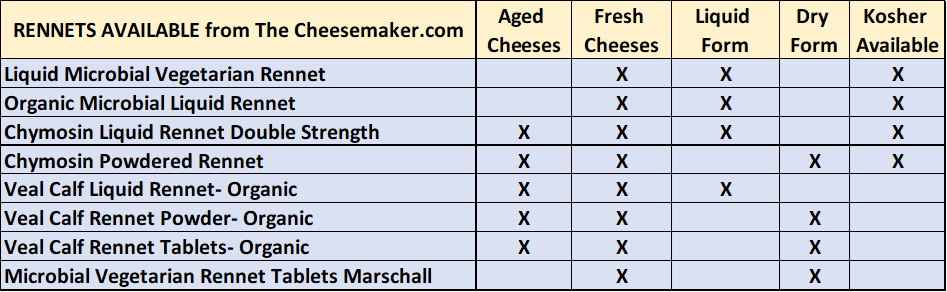
Rennet can be in liquid form; powder form; and tablet form.
Rennet can be sourced as animal rennet (primarily calf rennet) or from the fermentation of the fungus Saccharomyces (Kluyveromyces) lactis.
Old world rennet came from the stomach lining of animals; and today the same style of rennet is calf rennet (often termed ‘veal calf rennet’ or just ‘animal rennet’) and is a very effective rennet for making any type cheese whether fresh soft cheeses or long aged cheeses.
It has also been found that the enzyme chymosin is prevalent in a strain of fungus which can be cultivated and harvested as cheese making rennet. These rennets are also highly effective at forming curds in the cheese making process and are referred to as either ‘Microbial Rennet’, 'Vegetarian Rennet', or just ‘Chymosin’. Depending on the process and strength of the rennet, these rennets are great options for fresh cheeses and/or aged cheeses and are generally less costly than animal rennet.
Fermentation Produced Chymosin (FPC) is a gmo-free milk clotting enzyme produced by the fermentation of Saccharomyces (Kluyveromyces) lactis.
Using Rennet
Rennet works with Dairy Milk – it does not do anything for plant based milk.
Rennet works it’s best when milk is warmed between 70F – 105F; and also with an acid pH for the milk. That is one of the reasons starter cultures are used; they lower the pH in the milk be consuming lactose and producing lactic acid.
Using rennet with milk that’s been pasteurized may not produce strong curds UNLESS you first add calcium chloride (cheese making recipes will reflect this).
Ultra Pasteurized milk (high heat for a shorter period than traditional pasteurization) generally will not yield very strong curds even if you use Calcium Chloride- avoid using Ultra Pasteurized milk when making cheese.
When adding rennet we recommend rennet be dlluted in a couple of tablespoons of filtered water before adding to the milk. This will allow what is a small amount of rennet to disperse more evenly.
When you stir in the rennet after adding; do NOT stir vigorously. Use a few up and down motions only to disperse the rennet into the milk. Rennet begins to act very quicly and you can disturb the initial curds that are forming by stirring too much when adding your rennet.
Recipes will give you guidance on how long to wait after adding Rennet. Many recipes suggest 45 minutes to an hour to let the curds form.
Proper curd formation will be more or less a 'pudding type' texture that you can gently slide a knife into and see what is called a 'clean break' - separation of the solids and liquid. If you do not have a 'clean break' after the recommended time you can just let the rennet work awhile longer adn check again. There can be variability between the strength of different rennets, as well as the pH an temperatures of the milk so it's not always as precise as 'wait xxx ' minutes and move on the next step (which will be 'cutting the curds'!)
If you'd like any recommendations about which Rennet to choose- give us a call we are happy to discuss it with you !